

Genesis Leaves the Launch Pad
From Executive Order to operating architecture: what the Genesis Mission has actually built since November - Article #163

In this 15-minute article, The X Project will answer these questions:
I. Why this article now?
II. What has the Genesis Mission actually accomplished since its launch?
III. What is the American Science and Security Platform becoming?
IV. Why do the 26 national science and technology challenges matter?
V. What has Genesis done to turn government data into a strategic asset?
VI. How is Genesis trying to make AI useful for science rather than just impressive?
VII. How has Genesis expanded beyond DOE into a public-private and international ecosystem?
VIII. What should The X Project reader conclude from all of this?
IX. Why should you care?
X. What does The X Project Guy have to say?
Reminder: nothing The X Project writes or says should be considered investment advice or recommendations to buy or sell securities or investment products. Everything written and said is for informational purposes only, and you should do your own research and due diligence. It is recommended that you consult an investment advisor before making any investments or changes to your investments, based on information provided by The X Project.
I. Why this article now?
On June 4th, there was some rare mainstream news of the Genesis Mission: United States and Japan Announce Historic $1 Billion Partnership Under President Trump’s Genesis Mission. The Genesis Mission was originally announced on November 4th, 2025, and there has been little mainstream news coverage since.
The X Project covered the original announcement in article #137, “The Genesis Mission and Quatrovision: The White House’s Latest Executive Order & Dr. Pippa’s Provocative Insights on a New Creation Story for American Power, Science, & The Future Economy.” Dr Pippa has regularly been discussing the significance of the Genesis Mission since its launch, but few others have been talking about it.
So when I heard of the partnership with Japan, I decided to dig into the Genesis Mission website and see what’s been happening since the original announcement.
The X Project curates, summarizes, distills, and synthesizes knowledge & learning at the interseXion of economics, geopolitics, money, interest rates, debts, deficits, energy, commodities, demographics, & markets - helping you know what you need to know. The Genesis Mission sits squarely at that intersection, and you need to know what it is and why it is important.
II. What has the Genesis Mission actually accomplished since its launch?
The biggest change since last November is that Genesis has moved from announcement to architecture. The original article focused on the Executive Order, the Manhattan Project analogy, and the broader conceptual frame around AI-accelerated science. This update is different: the story now is execution. Since launch, the Genesis Mission has produced a formal platform strategy, a portfolio of national challenges, dedicated implementation teams, funding vehicles, a public-private consortium, early supercomputing plans, and an international partnership with Japan.
That matters because Genesis is not being treated as a normal grant program or one-off AI initiative. It is being built as a national operating system for science and engineering. The Department of Energy is trying to integrate national lab data, supercomputers, AI models, experimental facilities, production infrastructure, universities, private companies, and allied scientific institutions into a single coordinated discovery engine.
The phrase that best captures the update is this: Genesis is becoming institutional infrastructure. The American Science and Security Platform is the core engine. The 26 national science and technology challenges are the mission roadmap. The data, models, infrastructure, challenges, and public-private partnership teams are the operating units. The Consortium and Partnership Exchange are the outside-in collaboration layer.
The accomplishment, therefore, is not yet “fusion solved” or “materials revolution delivered.” It is that the scaffolding for faster science is being assembled at an unusually fast pace. The early evidence suggests Genesis is now an organized national mobilization around AI for science, energy, manufacturing, national security, and industrial competitiveness—not merely a headline-grabbing Executive Order.
III. What is the American Science and Security Platform becoming?
The American Science and Security Platform is the core of the Genesis Mission. It is designed to integrate high-performance computing, scientific experimental facilities, data resources, and production capabilities into a single AI-driven discovery system. In plain English, DOE is trying to turn the national laboratory complex into a connected scientific instrument.
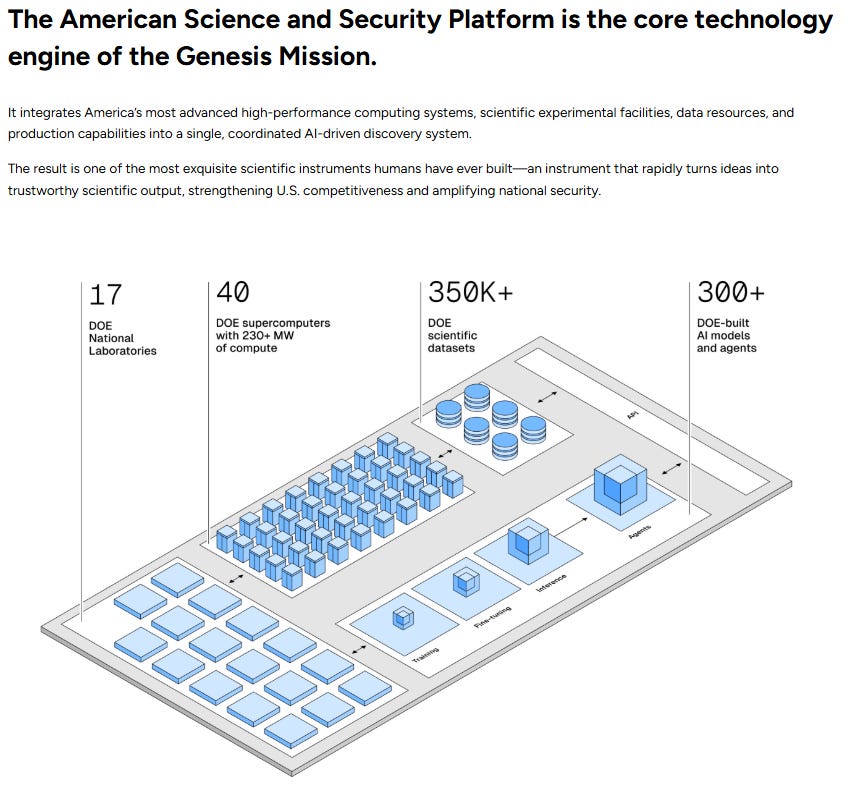
That is the key distinction. Genesis is not just “using AI.” It is building the infrastructure that allows AI agents, models, simulations, datasets, robotic labs, and production systems to work together. The original Executive Order described the platform as combining supercomputers, secure cloud AI environments, AI agents, domain foundation models, datasets, synthetic data, and autonomous experimentation tools. The later DOE materials show those pieces being assigned to dedicated teams.
The infrastructure team is focused on the software and hardware layers: secure multi-agent workflows, hybrid cloud and high-performance computing, open and classified environments, and support for many scientific agents working on long-running tasks. The data team is building the governed data foundation: curated datasets, provenance, interoperability, access control, licensing, auditability, and traceability. The models team is developing DOE-tuned reasoning models, domain foundation models, surrogates, predictors, model repositories, and evaluation systems.
This is why Genesis should be understood as a platform rather than a list of projects. The platform is the compounding asset. If it works, each challenge does not have to start from scratch. Every new dataset, model, agent, lab workflow, and successful experiment can become reusable infrastructure for the next problem.
IV. Why do the 26 national science and technology challenges matter?
The 26 challenges are the clearest sign that Genesis has moved from abstraction to targets. They turn the big idea—AI-accelerated scientific discovery—into concrete national missions. The list spans advanced manufacturing, buildings, biotechnology, critical minerals, nuclear energy, fusion, nuclear cleanup, quantum algorithms, quantum systems, microelectronics, data centers, materials, autonomous laboratories, particle accelerators, water, the grid, subsurface energy, nuclear threat response, and nuclear deterrence.
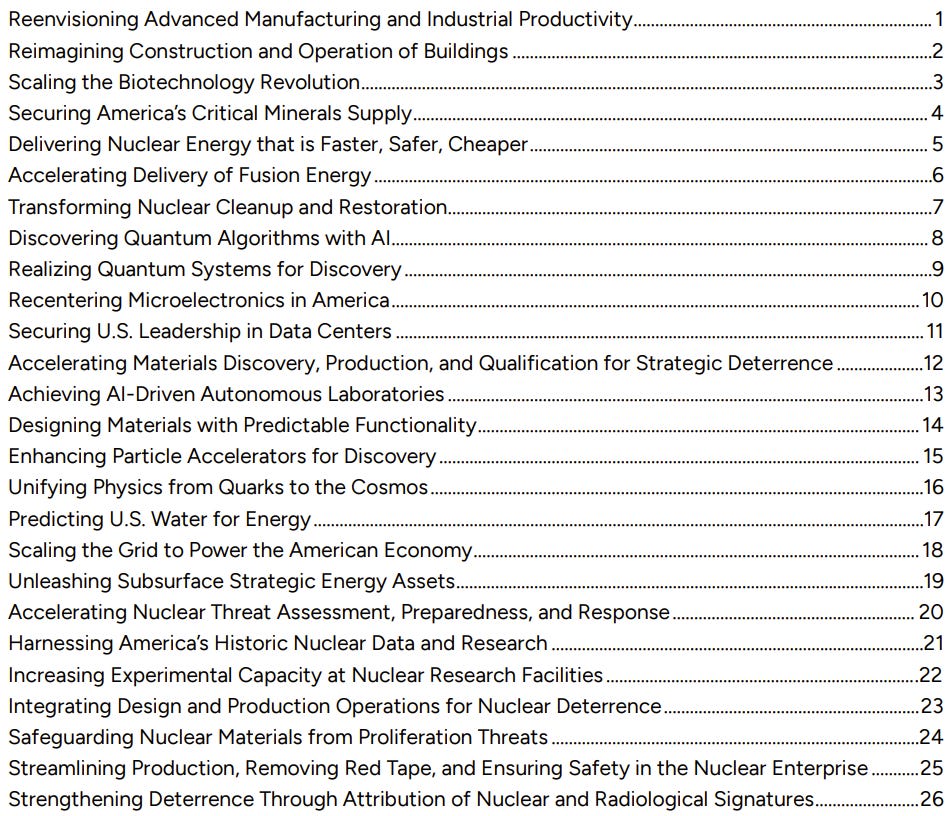
These challenges matter because they are not random research topics. They sit at the intersection of energy, national security, industrial policy, supply chains, and technological leadership. They are the areas where faster discovery could translate into lower energy costs, stronger manufacturing capacity, more resilient grids, domestic critical mineral supply, faster nuclear deployment, better data center integration, and new materials for defense and industry.
They also serve as stress tests for the platform. DOE describes the challenges as closed-loop systems that bring together data, models, agents, experiments, and production to compress time-to-solution from years to months. That phrase is important. The point is not only to publish more papers. The point is to shorten the cycle from hypothesis to simulation to experiment to prototype to deployment.
Several examples show the ambition. Grid planning could become 20 to 100 times faster while improving electricity cost and reliability. Materials development timelines could shrink from decades to months. Nuclear energy deployment is being framed around faster design, licensing, manufacturing, construction, and operation. Autonomous labs are meant to speed discovery of drugs, advanced materials, and next-generation energy technologies. This is science as industrial acceleration.
V. What has Genesis done to turn government data into a strategic asset?
One of the most important accomplishments is less visible than the supercomputer headlines: the creation of a data architecture. DOE and NNSA sit on decades of experimental, simulation, operational, product realization, nuclear, energy, materials, and engineering data. Genesis is trying to turn those scattered datasets into an organized national asset for AI-driven discovery.
The data team’s role is to curate, connect, and prepare those data resources so they can strengthen reasoning, modeling, and decision-making. That means building a foundational data framework, automating curation and transformation, standardizing interfaces, and ensuring data quality. The goal is not simply to collect data; it is to make data reusable, traceable, discoverable, and trustworthy.
That trust layer matters because scientific AI is only as good as the data, provenance, and validation behind it. If Genesis is going to operate across nuclear, energy, defense, materials, biotechnology, and classified environments, then it needs fine-grained access control, licensing, auditability, digital provenance, and repeatable verification standards. Otherwise, the platform becomes powerful but not reliable.
This is one reason Genesis could become more durable than a typical AI initiative. Most AI hype focuses on models. Genesis is emphasizing the boring-but-critical plumbing: metadata, standards, provenance, governance, secure access, and reproducibility. For scientific discovery, that plumbing is the difference between a demo and an institution.
VI. How is Genesis trying to make AI useful for science rather than just impressive?
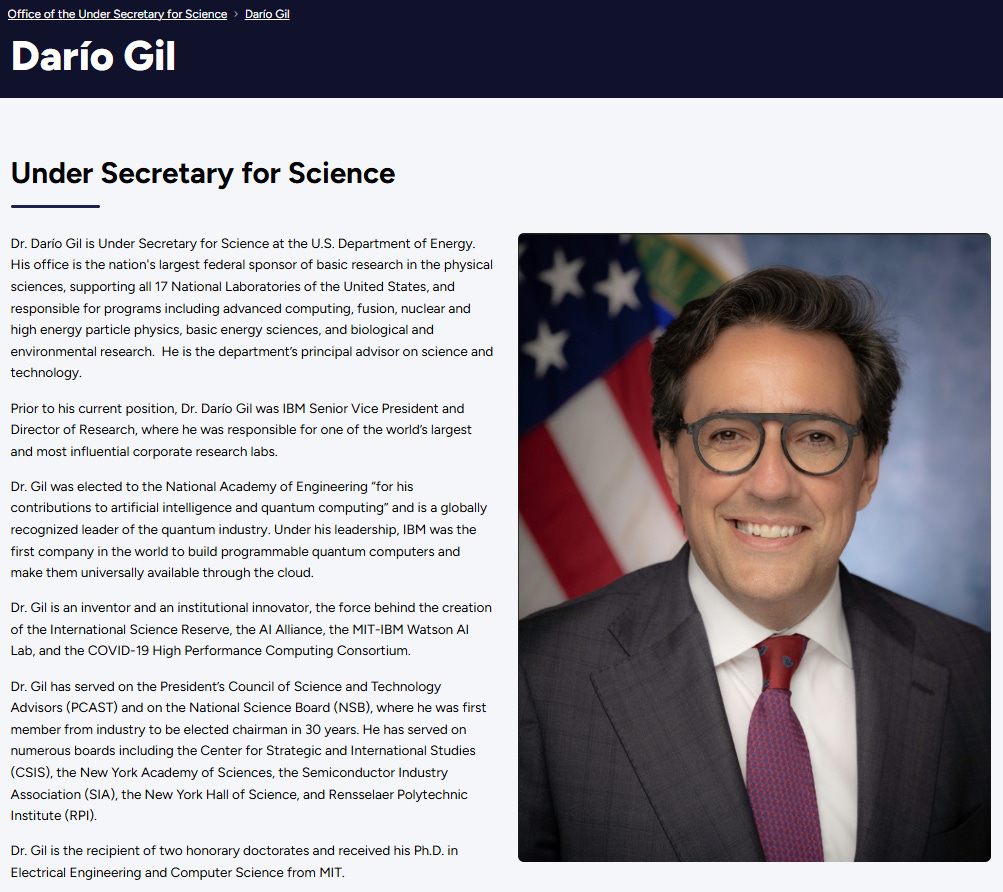
The key phrase from Darío Gil, the Under Secretary for Science at the U.S. Department of Energy, is that Genesis is “AI for something”—for science and engineering. That is an important correction to the usual AI conversation. The goal is not to celebrate AI as an end in itself. The goal is to use AI, high-performance computing, and eventually quantum computing to accelerate the actual work of scientists and engineers.
The models team is where this becomes real. Genesis is building AI agents that can help develop hypotheses, run simulations, execute experiments, manage production, and operate across high-performance computing and experimental facilities. It is also building domain foundation models, surrogates, and predictors for materials, chemistry, physics, biology, controls, and trusted systems.
Surrogate models are one of the most practical examples. Instead of running every expensive physics simulation from scratch, AI models can be trained on validated simulation outputs and then produce useful predictions much faster. In fusion, this could let researchers iterate on designs in hours or minutes rather than days, weeks, or months. In grid planning, AI emulators could dramatically speed up power-flow analysis.
The larger idea is an “internet of science.” In that vision, AI agents sit atop supercomputers, national lab instruments, robotic labs, datasets, and human experts. They do not replace the scientific enterprise; they connect it. If the platform works, Genesis could make the national lab system behave less like 17 separate institutions and more like one coordinated discovery network.
VII. How has Genesis expanded beyond DOE into a public-private and international ecosystem?
Genesis has also made progress on the ecosystem problem. DOE cannot do this alone, and the documents are unusually explicit about that. The national labs bring domain expertise, unique instruments, national security missions, and hard scientific data. Industry brings frontier AI models, compute scale, engineering speed, and capital. Universities bring research depth and the next generation of talent.
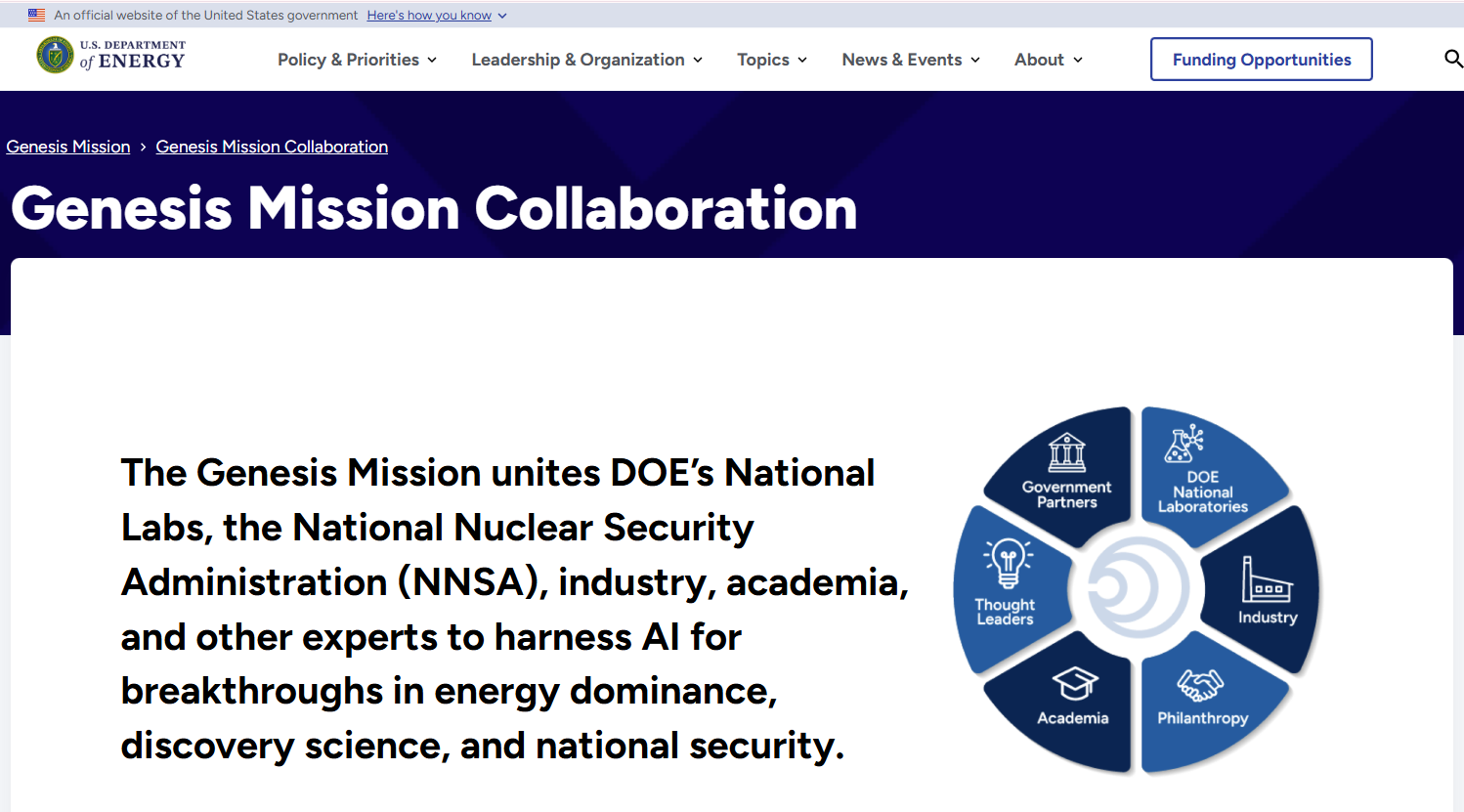
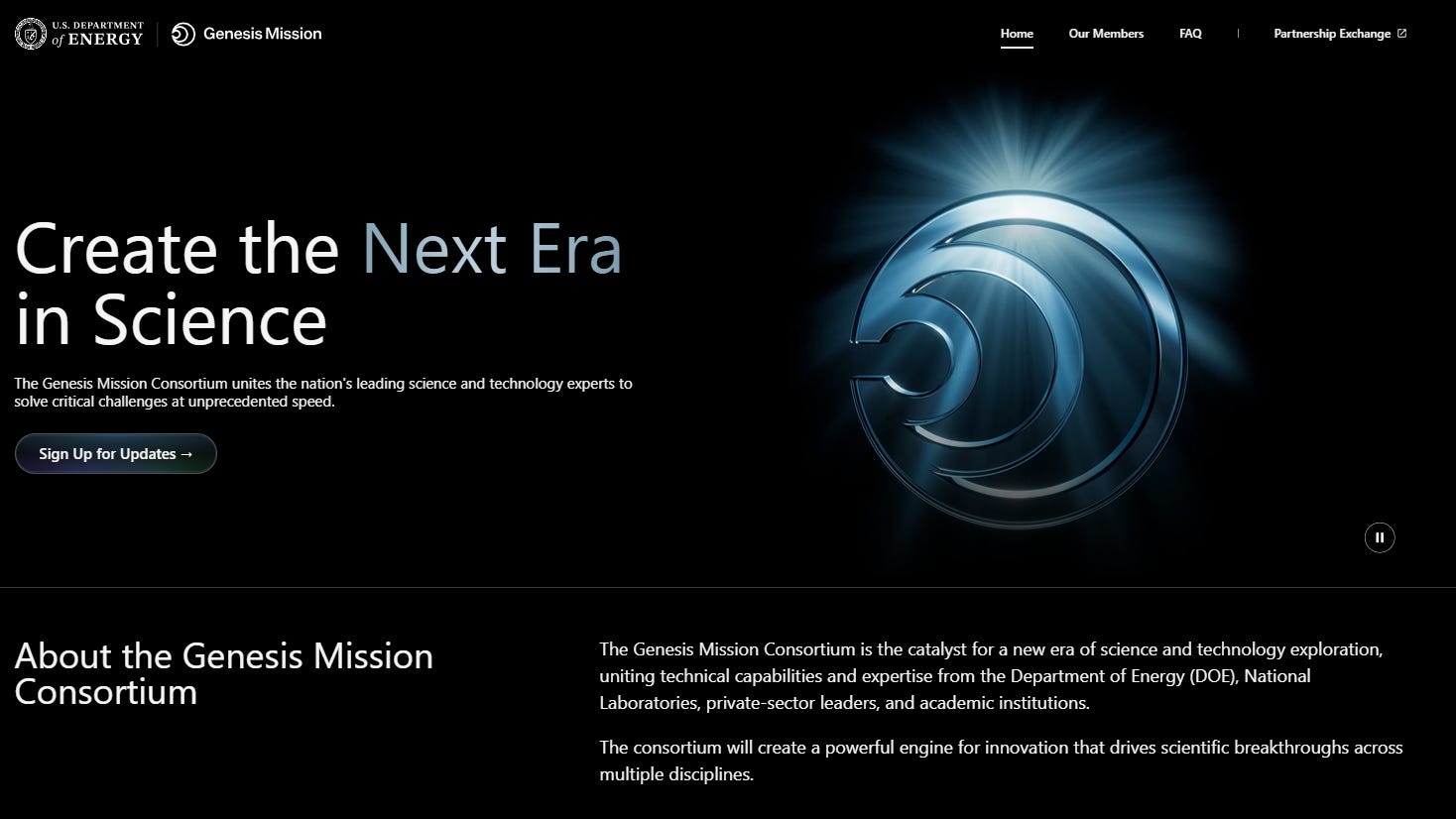
The Genesis Mission Consortium is the mechanism for that collaboration. It is designed to unite DOE, national laboratories, private-sector leaders, and academic institutions. Members are expected to contribute computing power, AI tokens, technical expertise, personnel time, data, financial support, or in-kind resources. Its working groups focus on AI model development and validation, data integration and standards, high-performance computing and cloud infrastructure, and robotics and automation.
The Partnership Exchange adds a practical matchmaking layer. Organizations and researchers can create profiles, identify funding opportunities, share technical capabilities, browse potential partners, send connection requests, and eventually receive automated partner suggestions. That may sound administrative, but it is essential. If the mission depends on multidisciplinary teams, then team formation itself becomes infrastructure.
The most striking expansion is international: the United States and Japan announced a $1 billion strategic partnership, making Japan the first international partner in the Genesis Mission. Eleven joint scientific teams will connect twelve DOE National Laboratories, one DOE Office of Science User Facility, and twelve Japanese research institutions across quantum information science, fusion, biotechnology, advanced materials, particle physics, and autonomous laboratories. Genesis is no longer just a domestic science initiative; it is becoming an allied technology strategy.
VIII. What should The X Project reader conclude from all of this?
The top conclusion is that Genesis is becoming a serious industrial policy platform for science. It is not just about AI, and it is not just about research. It is about whether the United States can leverage AI, data, compute, national labs, private capital, universities, and allies to accelerate discovery in the strategic sectors shaping energy, defense, manufacturing, semiconductors, biotechnology, materials, and the grid.
The second conclusion is that Genesis is closely tied to the energy-AI feedback loop. AI needs electricity, data centers, chips, cooling, transmission, nuclear power, gas, advanced materials, and grid modernization. At the same time, AI may be one of the tools used to solve the energy bottlenecks it is helping create. That makes Genesis relevant to power markets, commodities, industrial supply chains, utilities, data centers, nuclear, fusion, and critical minerals.
The third conclusion is that the mission is still early, and execution risk is real. Funding, Congress, cybersecurity, classification, IP rights, partner coordination, model reliability, talent development, and platform integration all matter. A platform this ambitious can fail in many ways: too much bureaucracy, too little funding, weak governance, incompatible systems, overpromising, or scientific results that take longer than political timelines allow.
But if Genesis works, it could become one of the most important pieces of U.S. state capacity in the AI era. It would mean faster discovery, shorter development cycles, more productive R&D spending, stronger national labs, deeper public-private collaboration, and a new model for allied technological competition. For The X Project reader, the question is no longer “What is Genesis?” The question is: what happens if the United States actually learns how to run science at AI speed?
IX. Why should you care?
Genesis matters because it may become one of the clearest signals of where the next decade of American power is heading. For the past couple of years, The X Project has followed the same big forces: debt, deficits, energy constraints, deglobalization, industrial policy, supply chains, commodities, and great-power competition. Genesis sits at the intersection of all of them. It is a bet that America’s future advantage will not come only from cheaper capital, larger deficits, or financial engineering, but from compressing the time it takes to turn science into usable technology.
That has direct consequences for investors, workers, companies, and citizens. If Genesis succeeds even partially, the winners may be found around the physical economy: power generation, grid equipment, nuclear, data centers, advanced materials, semiconductors, automation, critical minerals, robotics, defense, and industrial software. It also means the next phase of AI may be less about chatbots and more about laboratories, factories, reactors, transmission systems, and national security infrastructure. In other words, AI’s next major impact may show up not just in digital products, but in the cost, speed, and resilience of the real-world economy.
The reason to care is not that every promise in Genesis will be fulfilled. Large government missions can overpromise, underdeliver, and become bureaucratic. But the direction of travel is unmistakable: the U.S. government is trying to reorganize science around AI, energy abundance, strategic industries, and allied technological leadership. For The X Project reader, that makes Genesis a map of where policy, capital, engineering talent, and geopolitical urgency may increasingly converge. Whether it becomes a breakthrough machine or merely a signpost, it points to the same conclusion: the next economic cycle may be shaped less by Wall Street and more by the race to rebuild the foundations of American industrial power.
X. What does The X Project Guy have to say?
The problems are mounting. The U.S. Government’s measures of inflation, CPI and PPI, came in above expectations last week; both are at the highest levels in years and rising. Long-time readers of The X Project know that I have been concerned and warning about the risks of a longer period of secularly higher inflation that leads to monetary debasement.
Meanwhile, the federal government’s debt situation continues to worsen, with ongoing federal deficits adding to the now-greater-than-$39.25T in U.S. Government debt.

With new debt continuing to be issued at the short end of the yield curve, the U.S. Government needs to roll over ~$8T in existing debt over the next 12 months, putting enormous supply pressure on U.S. Government debt markets. Again, I have been warning about the ultimate monetization of debt and yield-curve control, leading to greater monetary debasement and higher, more secular inflation.
The list of problems is long, and I could go on…
One could say the United States needs a miracle (play the Grateful Dead’s “I Need a Miracle”). What does a “miracle” look like? It looks like a solution to the 26 challenges listed above that leads to massive growth, productivity gains, and employment growth, with rising real wages amid disinflation.
The Genesis Mission proves to me that this administration is well aware of the problems we are facing and pulling out all the stops in search of a miracle to save us from the pain of inflation, slowing growth or a recession or a depression, debt monetization, and yield curve control.
Will the miracle come in time? I doubt it. Will the Genesis Mission create a foundation for the recovery that follows whatever happens from all these problems? I think so. What am I doing about it?
18 articles ago, I put up a paywall and started sharing details of my discretionary investment account, which began in April of 2022, based on The X Project investment themes, as shared in early 2024 and in most of my articles in 2024 and 2025. Please go back and read them if you haven’t already, as most are still very relevant today.
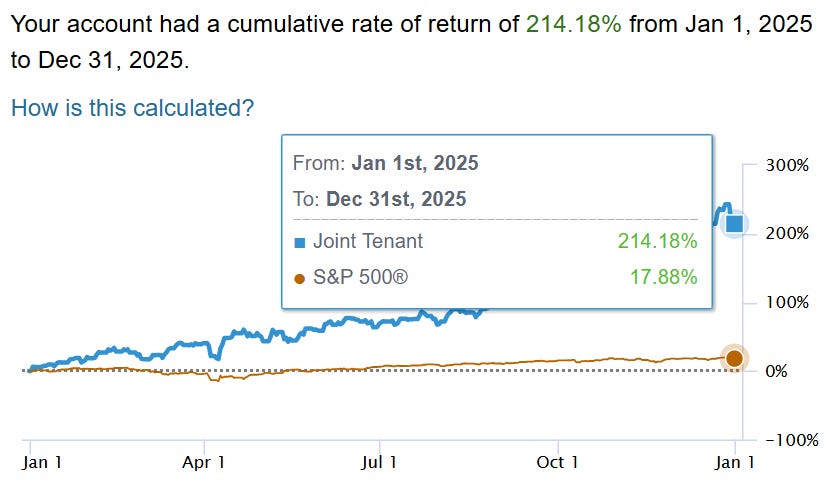
The X Project investment account (not including my physical bullion) is up 6.7x over the past four years. It was up 214% last year (12x vs. the S&P 500) according to Schwab:
If you are interested in the details of my investment account and how I am managing it, please consider becoming a paid subscriber.
Keep reading with a 7-day free trial
Subscribe to The X Project’s Substack to keep reading this post and get 7 days of free access to the full post archives.