

Reverse Perestroika
Michael Every on the Soviet Mirror, Economic Statecraft, and Stablecoins - Article #148

In this 15-minute article, The X Project will answer these questions:
I. Why this article now?
II. Is the United States Attempting a “Reverse Perestroika”?
III. Was the Pre-Trump U.S. System More Soviet Than It Appeared?
IV. What Does “Economic Statecraft” Replace?
V. Could Stablecoins Fragment the Dollar System?
VI. What Is the “Reverse Marshall Plan”?
VII. Where Could This Project Fail?
VIII. Is This Transformation Sustainable — or Systemic Risk?
IX. Why should you care?
X. What does The X Project Guy have to say?
Reminder for readers and listeners: nothing The X Project writes or says should be considered investment advice or recommendations to buy or sell securities or investment products. Everything written and said is for informational purposes only, and you should do your own research and due diligence. It is recommended that you consult an investment advisor before making any investments or changes to your investments, based on information provided by The X Project.
I. Why this article now?
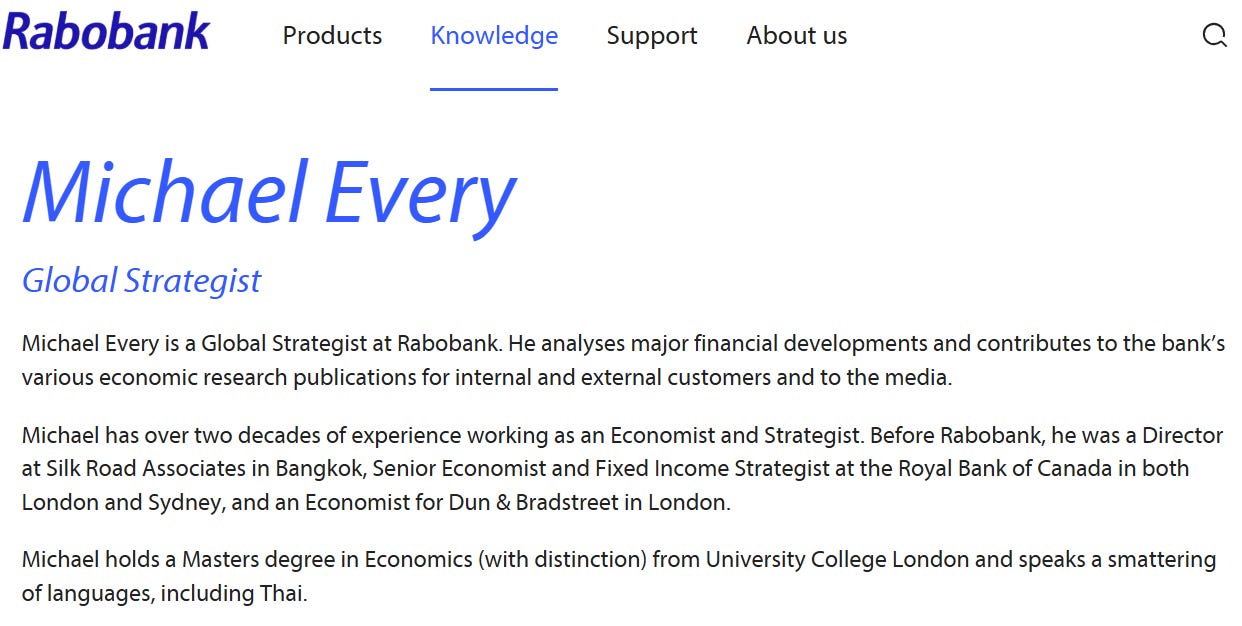
Over the last couple of weeks, I have listened to several recent interviews with Michael Every, which I found to be among the most profound and provocative ideas I’ve heard, particularly around “Reverse Perestroika” and how U.S. stablecoins could be leveraged.
I first introduced readers of The X Project to Michael Every and Economic Statecraft in article #107: “Say Goodbye to the Liberal World Order: It’s been falling apart for over a decade, and now it’s time to welcome Economic Statecraft.” I highly recommend that you stop, click the article, and read or re-read it before moving on.
An important point to keep in mind, especially if you have strong feelings about politics, is that what has happened, is happening, and is going to happen is on a trajectory and timeline that transcends political administrations and personalities. What is happening and what will ultimately happen are driven by geopolitical necessity. To fully comprehend, please set aside your political feelings and your personal feelings toward political personalities.
The X Project curates, summarizes, distills, and synthesizes knowledge & learning at the interseXion of economics, geopolitics, money, interest rates, debts, deficits, energy, commodities, demographics, & markets - helping you know what you need to know. This week, I am summarizing, distilling, and synthesizing the following interviews:
The Grant Williams Podcast Ep. 115 - Michael Every FULL EPISODE
“Globalization Has Failed” Declaration By USA = MASSIVE Change Is Ahead | Michael Every
MacroVoices #520 Michael Every: USD Stablecoins in The Age of Economic Statecraft
When Grant Williams, Adam Taggart, and Erik Townsend all talk to the same guy within two weeks, I definitely listen and pay attention.
II. Is the United States Attempting a “Reverse Perestroika”?
Michael Every’s headline analogy is that the U.S. is attempting something like a reverse of the Soviet Union’s late-1980s reform effort. In his telling, Gorbachev inherited a superpower that could still project strength, but whose economic structure was badly skewed: heavy emphasis on capital stock and military output, persistent shortages of consumer goods, and “repressed inflation” expressed as empty shelves rather than higher prices. When Gorbachev tried to “reconstruct” the system (perestroika) while also loosening speech and control (glasnost), he created a destabilizing mix: the economic reforms were partial and messy, while the political openness worked too well—people used it to attack the system itself. The end result was system failure, attempted rollback, and collapse.
Every argues the U.S. now faces the mirror-image structural problem. Instead of an economy that overbuilds industrial capacity and underdelivers consumer welfare, the U.S. economy has become “overly financialized” and consumption-heavy, with too little investment in productive capacity—especially the capacity that matters for strategic competition. He links this to a broader thesis: the “liberal world order” rests on American muscle, and that muscle has been undermined by decades of choices that favored the financial and consumer model over industrial depth. As relative strength declines, the U.S. begins to walk away from the old rules and rebuild strength using a toolkit that looks less like “neutral technocracy” and more like direct strategic economic steering.
This is why he’s adamant the current debate about whether the Fed is “hawkish or dovish” misses the point. In a world of economic statecraft, the goal is not simply to optimize CPI prints or to keep markets happy; it’s to move “USA Inc.” toward a desired end-state, even if different parts of the economy need different financial conditions to get there. That’s the essence of his reverse-perestroika claim: not “a policy tweak,” but a shift in what the system is for.
The open risk, which he repeatedly emphasizes, is that large-scale system rewiring is inherently unstable. Gorbachev tried to reform what had to be reformed—and still lost control of the process. Every’s analogy is meant to force that uncomfortable question: does the U.S. have a path to controlled transformation, or is it walking into the classic trap where necessary reform triggers cascading political, market, and geopolitical blowback?
III. Was the Pre-Trump U.S. System More Soviet Than It Appeared?
Every’s “Soviet mirror” isn’t that America became a planned economy. It’s that the functional outcomes—soft budget constraints, distorted prices, capital misallocation—start to rhyme in uncomfortable ways, just produced by different institutions. He describes the Soviet model as explicit central planning: Gosplan sets output targets, Gossnab allocates capital goods, Gosbank monetizes losses and enforces tight capital controls, ministries refine sector plans, and prices are administered rather than discovered. It’s a system that can build capital stock quickly because money can’t “escape” into alternatives—but it can also destroy value through misallocation and chronic inefficiency.
By contrast, his description of the late-cycle U.S. system is “free market” in branding but deeply managed in practice—especially where it matters most for stability and power. Treasuries sit at the base of the global collateral pyramid. Global demand for dollar assets effectively requires the U.S. to run persistent deficits and keep markets from clearing in a truly brutal way. The Fed, therefore, becomes a kind of stability engine whose job is to prevent the asset complex from collapsing because the whole global architecture rests on it. He’s blunt that the Fed may not say “our job is to keep assets unaffordably high,” but he treats that as the operational reality of “financial stability.”
He also leans on a telling statistic as a shorthand for “financialization”: he puts productive commercial/industrial lending at roughly 20% of U.S. bank loans—meaning most credit creation doesn’t build productive capacity but instead feeds consumption and intra-financial activity. In his statecraft frame, that’s not merely a moral critique; it’s a strategic problem. If the national objective is to rebuild industrial depth and compete in a zero-sum geopolitical environment, a system that naturally routes most credit into consumption/finance is misaligned with the mission.
So the “Soviet” element here is not commissars setting shoe quotas. It’s the idea that once a system is constructed to maintain a particular stability regime (whether through explicit planning or implicit backstops), capital allocation ceases to be purely market-driven. Every’s thesis is that the U.S. is now being forced to admit that reality—and then formalize it in a more openly strategic direction.
IV. What Does “Economic Statecraft” Replace?
Every’s term “economic statecraft” is the replacement of technocratic optimization with strategic direction-setting. In the old posture, the economy is treated like a machine: adjust the policy rate, communicate forward guidance, keep inflation near target, and let markets allocate. In the new posture, the economy is treated like a tool of national power. It’s not “what delivers the cleanest Phillips Curve outcome,” but “what delivers the industrial base, supply chain control, and geopolitical leverage the state needs.”
That’s why he sees a “new Fed” as central to the story—not as a personality swap, but as an institutional transformation. In his view, if the national security strategy is explicitly fused with the economic security strategy, it becomes incoherent to pretend the central bank can be fully independent and purely inflation-targeting. He argues that this is not historically radical: during earlier eras (including the Cold War), Western market economies used credit rationing, sector quotas, and other tools to steer capital toward priority areas. What’s radical is how unthinkable those tools have become after decades of ideology about neutral markets and independent central banking.
The policy implications he sketches are expansive: differential borrowing costs by sector, new approaches to inflation targeting (because “one inflation rate” is not the only thing the state cares about), varied forms of QE (including “bricks and mortar” approaches he contrasts with pure financial-asset buying), yield curve control, capital controls, and a reshaped use of swap lines and international dollar plumbing. He’s careful not to present these as a precise forecast of the Fed’s next press conference, but he’s very explicit that statecraft logic pushes in this direction.
Put simply, “economic statecraft” replaces the idea that monetary and fiscal tools exist to stabilize the cycle with the idea that they exist to reshape the structure. That’s why his stablecoin thesis (next section) matters so much: it’s not an innovation story—it’s a structural story about how the U.S. might rewire the system’s incentives and funding channels to match a strategic end-state.
V. Could Stablecoins Fragment the Dollar System?
Every’s most distinctive claim in these interviews is that dollar stablecoins could be used to change the geometry of global dollar power. He’s clear that most discussions miss the point by treating stablecoins as just another “risk asset” or a fintech novelty. In his frame, they resemble historic instruments like sterling bills of exchange: private promissory notes widely accepted in trade, tied to a core reserve asset (then sterling/gold), but not issued directly by the central bank. That historical analogy matters because it makes stablecoins legible as private money serving state ends—without needing to call it a CBDC.
Mechanically, he describes a balance-sheet dynamic where stablecoins pull dollars back onshore. A foreign holder exchanges local currency through the chain, which ultimately converts it into dollars and then into T-bills held by the stablecoin issuer. The foreign user ends up holding a digital token “backed” by Treasuries, while the Treasuries remain in U.S. hands. In that structure, the U.S. could gain cheaper short-end funding (more T-bill demand), potentially refinance more cheaply, and reduce some external vulnerability—because what the world holds is a tokenized claim rather than a traditional dollar liability.
The trade angle intensifies this. He suggests U.S. importers could pay foreign exporters in stablecoins rather than bank dollars: dollars go to the stablecoin issuer, who buys T-bills, while the exporter gets the token. This is where his “valuta ruble” analogy enters: a trade-credit-like instrument that can circulate and settle within the network while the “hard” collateral sits inside the issuing center. If the U.S. can then encourage—or require—those tokens to be recycled back into U.S. strategic investment (factory building, shipyards, defense supply chains), stablecoins become a channel that links trade settlement, Treasury financing, and industrial policy.
Crucially, he argues that stablecoins could allow the U.S. to partially sidestep the Triffin dilemma: instead of needing to send ever more dollars offshore (and thus ever more deficits), the U.S. can send tokenized claims while keeping the Treasury's collateral base concentrated domestically. That’s what he means by “fragmenting” a fully fungible global dollar system into something more managed and strategically useful—especially if paired with differential onshore/offshore rates and selective restrictions.
VI. What Is the “Reverse Marshall Plan”?
Every describes a world where allies are no longer merely asked to “support” the U.S. order; they’re asked to rebalance it materially by putting capital to work in U.S. productive capacity. The postwar Marshall Plan exported American capital to rebuild allied industrial bases. The reverse version leans on surplus countries—those that accumulated capital by exporting into U.S. demand—to reinvest not in Treasuries and Wall Street assets, but in U.S. factories, supply chains, and defense-relevant capacity.
This is where his statecraft lens changes the meaning of “investment.” Private investors typically chase the highest risk-adjusted returns. Every argues that statecraft logic instead channels capital into long-term strategic sectors, even if they aren’t the most lucrative in a pure market sense. He points to discussions involving Japan and South Korea where the “blueprints” are framed as strategic allocations: invest here, build this, align supply chains—less as portfolio preference and more as alliance architecture.
Stablecoins then become a potential enforcement mechanism. If trade is settled through stablecoin rails, and if those rails sit inside a broader system of “where capital is allowed to go,” you can link settlement flows to investment obligations. Every’s “buy one, get one free” framing captures the idea: trade settlement creates the token flow; policy can then steer the token flow back into U.S.-desired investment channels.
At the extreme, this begins to resemble a bloc-based development model: allied economies become more integrated, more planned at the macro level, and more “closed loop” in terms of investment recycling—while rival blocs are progressively excluded or pushed toward alternative rails (he floats Bitcoin as a potential “neutral” alternative for non-aligned actors).
VII. Where Could This Project Fail?
Every repeatedly returns to a simple reality: system change creates system stress. He frames the core vulnerabilities as a triangle of inflation, asset markets, and political resistance—and he treats all three as unavoidable.
On inflation, his argument is straightforward: reshoring, defense buildup, and labor tightening are inflationary forces. So is the attempt to redirect credit from consumption/finance toward capital stock formation. The political danger lies in the sequencing: voters feel higher prices before they feel industrial renewal, and, per his Soviet analogy, partial or poorly executed transitions tend to generate the worst of both worlds—pain without the promised payoff.
On asset markets, he stresses the U.S. system is deeply financialized and structurally reliant on capital inflows. If the U.S. breaks the old model before the new one is credible, global capital can wobble, risk premia can rise, and the “sell America” impulse can become politically destabilizing. This isn’t just about stock indices—it’s about how much of American perceived stability is now tied to asset values and the idea that the Fed will always backstop the system.
On political resistance, Every is explicit that vested interests will fight to preserve the old regime. He draws the parallel to the Soviet attempted coup against Gorbachev: the more radical the transformation, the more intense the backlash. In the U.S. context, he frames this as a struggle between a statecraft agenda and entrenched institutional power centers that benefited from decades of financialization.
Finally, he adds an implicit fourth variable: bloc cohesion. If you can’t assemble a credible “Warsaw Pact” of aligned economies—whether through persuasion, incentives, or coercion—then you can’t cushion the inflationary and market volatility effects of the transition. The more fractured the alliance system, the more the U.S. bears the adjustment cost directly.
VIII. Is This Transformation Sustainable — or Systemic Risk?
Every’s posture is not “this is good” or “this is bad.” It’s “this is what the logic of the moment implies.” He argues the old structure was already failing key tests: it didn’t rebuild industrial capacity, it increased inequality, it deepened polarization, and it slowly eroded the military-industrial base that underwrote the broader order. In his telling, that makes radical restructuring more likely—not because it’s neat, but because it's the least-bad available option.
Yet he also highlights the paradox: the more necessary the reform, the harder it is to execute democratically and peacefully. Gorbachev’s reforms were necessary. They still unraveled because they were partial, contested, and overtaken by political dynamics once openness took hold. Every’s “Trump as Gorbachev” analogy is fundamentally a warning about transition risk: reform can be both the only path forward and the mechanism that triggers collapse.
Stablecoins, in this context, are not a side plot. They’re a candidate “escape hatch” from the most binding constraints—particularly the fiscal and external constraints of the existing global dollar system. If stablecoins can attract onshore funding, lower Treasury financing costs, and create a managed trade-and-investment circuit within an aligned bloc, they may help the U.S. execute a structural transition with less immediate pain than traditional levers would allow.
But the same tool can intensify fragmentation and mistrust. Every acknowledges that coercion and credibility matter: if countries fear the U.S. can “cancel” tokens, or if they see stablecoin rails as a trap, they may seek exits from day one. That is why his vision trends toward a world of multiple architectures—different blocs, different rails, and less universal integration than the post-Cold War era.
IX. Why should you care?
Michael Every’s core thesis is not that America is becoming Soviet. It is that systemic restructuring — like in the late Soviet period — is underway. Stablecoins, industrial policy, capital controls, and alliance fragmentation are not isolated developments. They are components of a broader shift from a liberal economic order to a strategic economic architecture.
Whether this reverse perestroika rebuilds primacy — or fractures it — remains the defining macro question of the decade. Either scenario supports the investment themes to which I’ve subscribed since 2022:
Overweight cash and short-term U.S. T-bills for optionality, given expected INCREASING volatility related to the remaining list below.
Bullish gold and gold miner equities
Bullish Bitcoin
(Please note that I have been flat Bitcoin for nearly a year now - as I’ve shared multiple times in past articles, and while I agree with Luke Gromen that Bitcoin will eventually move higher, it is likely to move much lower first.)
Bullish oil and oil-related equities
Bullish natural gas and related equities
Bullish uranium and related equities
Bullish industrial-associated commodities and equities
Bullish agricultural-associated commodities and equities
Bullish industrial and primarily electrical infrastructure equities
Bearish long-dated U.S. and other Western sovereign bonds
Since April 2022, when I first opened my discretionary investment account to invest according to these themes, my account is up 746%. Last year, it was up 214%, and so far this year it is up 33%.
Starting with article #145 (this is article #148), I put up a paywall to share details of my portfolio with paying subscribers. So far, I have shared:
My top 20 holdings ranked by percentage of total liquidating value
My top 20 holdings ranked by profit loss percentage
My 21 holdings in the uranium sector
My 36 holdings in the oil and gas sector
In each article since I put up the paywall, I share any new holdings added and any additions or liquidations to existing holdings since the previous article
I will share additional details this week in the section below for paying subscribers. Please consider supporting my work by becoming a paying subscriber.
Keep reading with a 7-day free trial
Subscribe to The X Project’s Substack to keep reading this post and get 7 days of free access to the full post archives.