

The Technology Stack That Is Driving the Next Era
Stanford’s 2026 Emerging Technology Review of 10 technologies that are one converging system reshaping economic power, national security, and the future - Article #161

In this 15-minute article, The X Project will answer these questions:
I. Why this article now?
II. Why does Stanford call this a “hinge of history” moment?
III. Is AI becoming the new electricity of the global economy?
IV. Why could biotechnology become the next great manufacturing platform?
V. Why is energy still the constraint underneath the technology revolution?
VI. Why are chips, quantum, cryptography, and cybersecurity becoming strategic infrastructure?
VII. Why does Stanford worry that America’s innovation engine is weakening?
VIII. What does the report say about the new geopolitics of technology?
IX. Why should you care?
X. What does The X Project Guy have to say?
Reminder: nothing The X Project writes or says should be considered investment advice or recommendations to buy or sell securities or investment products. Everything written and said is for informational purposes only, and you should do your own research and due diligence. It is recommended that you consult an investment advisor before making any investments or changes to your investments, based on information provided by The X Project.
I. Why this article now?
Over the past few weeks, my X feed kept serving me references to the Stanford Emerging Technology Review 2026. At first, it looked like another long institutional report — important, impressive, but probably too broad and technical for a typical Saturday morning read. But the more I saw it, the more I realized it was not really a technology report. It was a map of the next phase of power.
That matters because this report arrived in the wake of something I wrote about six months ago: “The Genesis Mission and Quatrovision.” In November 2025, the White House launched Genesis as a national effort to accelerate AI-driven scientific discovery by integrating federal datasets, national laboratory infrastructure, supercomputing, AI agents, robotic laboratories, synthetic data, and private-sector participation into a single, integrated scientific platform. At the time, I argued that Genesis could be one of the most significant announcements in years — not because an executive order guarantees success, but because it showed the federal government attempting to turn AI into a national discovery engine.
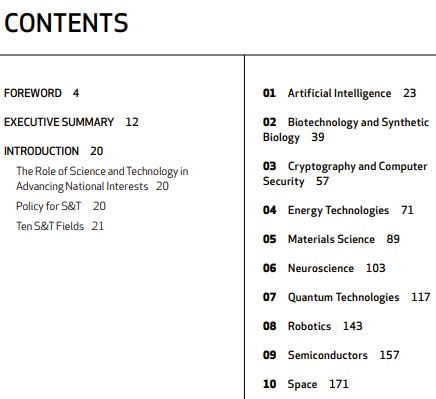
The Stanford report helps explain why Genesis matters. It gives the broader landscape. AI is not alone. It is converging with biotechnology, synthetic biology, quantum technologies, energy systems, semiconductors, robotics, space, materials science, cryptography, and neuroscience. These are no longer separate technology stories. They are becoming one integrated system — a new stack for economic growth, national security, industrial power, medicine, energy, and geopolitics.
That is why this article now. My X feed did not just push another report in front of me. It pushed a framework for understanding what Genesis may be trying to operationalize. Stanford describes the convergence. Genesis attempts to build the machine. My earlier article explored the more speculative and provocative interpretation of Genesis through Dr Pippa’s Quatrovision thesis. This article brings those threads together: the sober institutional assessment from Stanford, the explicit federal mobilization in the Genesis Mission, and the larger question The X Project keeps returning to — what happens when the old economic order meets a technological acceleration it is not prepared to absorb?
The short answer is that the next era may not be defined by one breakthrough. It may be defined by the simultaneous interaction of many breakthroughs. AI accelerates science. Chips enable AI. Energy constrains chips and data centers. Biotechnology turns information into physical production. Quantum challenges encryption and enables new sensing. Robotics changes labor and war. Space becomes commercial, military, and infrastructural. Materials science becomes the hidden enabler beneath it all. This is not just innovation. It is a system-level transformation.
And system-level transformation is exactly what The X Project exists to track. Economics, geopolitics, money, interest rates, debts, deficits, energy, commodities, demographics, and markets do not sit outside this technological shift. They are going to be reshaped by it. The question is whether we recognize the shift early enough to understand what it means — before it shows up as a market crash, an industrial boom, a geopolitical surprise, an energy shortage, a labor disruption, or a sudden reordering of what counts as valuable.
II. Why does Stanford call this a “hinge of history” moment?
The core message of the Stanford Emerging Technology Review 2026 is that emerging technology is no longer a side story. It is becoming the main story. Artificial intelligence, biotechnology, energy systems, semiconductors, quantum technologies, robotics, cryptography, materials science, neuroscience, and space are not just scientific fields. They are the new infrastructure of economic growth, national power, military capability, medical progress, and social trust.
The report’s most important insight is convergence. These technologies are no longer developing in isolation. AI accelerates materials discovery, drug design, robotics, cybersecurity, and scientific research. Semiconductors enable AI, quantum, robotics, and space. Energy systems determine whether AI data centers, advanced manufacturing, and electrification can scale. Biotechnology increasingly depends on computing, automation, and AI. Space depends on chips, robotics, communications, and materials. The world is not entering ten separate technology revolutions. It is entering one interconnected technological regime.
That is why Stanford frames this moment as both promising and dangerous. Breakthroughs could raise productivity, improve health, create new industries, reduce environmental stress, and expand human capability. But the same breakthroughs can also destabilize labor markets, create new security vulnerabilities, empower authoritarian surveillance, intensify great-power competition, and outpace the policy systems meant to govern them.
For The X Project reader, the report’s implication is straightforward: technology is now macro. It is no longer enough to analyze inflation, deficits, energy, commodities, markets, and geopolitics without understanding the underlying technology. The next phase of global power will be shaped not only by who has oil, capital, ships, and armies, but by who controls compute, chips, data, talent, energy infrastructure, biotech platforms, space assets, and the standards that tie them together.
III. Is AI becoming the new electricity of the global economy?
Stanford treats artificial intelligence as a foundational technology, comparable in significance to electricity or the internet. That does not mean AI is magic, and the report is careful not to describe it that way. It means AI is becoming a general-purpose capability that can be applied across nearly every sector: science, healthcare, law, logistics, agriculture, warfare, education, software, manufacturing, and government.
The report points to generative AI as a potential productivity engine, but it also emphasizes the infrastructure behind the magic trick. Advanced AI depends on enormous amounts of data, specialized chips, vast compute capacity, and large amounts of electricity. The report notes estimates that GPT-4 required roughly 25,000 Nvidia A100 chips running for about 100 days, with total hardware costs reaching at least hundreds of millions of dollars. That is not a consumer app story. That is an industrial infrastructure story.
AI’s promise is broad. It can help discover drugs, monitor patients, improve farming, automate legal review, assist programming, generate content, and eventually coordinate software tools through AI agents. But the report is equally clear about AI’s limits: today’s models still hallucinate, embed bias, lack explainability, are vulnerable to attack, and can produce unintended consequences. The more AI is embedded into healthcare, finance, military systems, courts, education, and public life, the more these weaknesses become systemic risks.
The deepest point is that AI is not just a technology race. It is a governance race, a compute race, a standards race, a talent race, and an energy race. Nations are competing not only to build better models but to shape the rules, platforms, infrastructure, and global norms around AI. For investors, executives, and citizens, AI should be understood less as a single product category and more as the operating layer embedded across the entire economy.
IV. Why could biotechnology become the next great manufacturing platform?
The report’s biotechnology chapter may be the most important section for readers who still think of biotech mainly as medicine. Stanford’s larger claim is that biotechnology and synthetic biology are emerging as general-purpose technologies. In plain English: once humans learn to encode a function in DNA, biology can potentially be used to grow that function wherever and whenever it is needed.
That is a radical idea. The report argues that biotechnology could move from centralized factories and specialized labs toward distributed biomanufacturing. Instead of manufacturing everything through traditional industrial processes, some products could be grown through engineered biological systems using local energy and material inputs. The report gives examples ranging from on-demand production of pharmaceutical ingredients to DNA data storage, bioengineered plants, engineered probiotics, skin microbes, synthetic cells, tissue printing, and electrobiosynthesis.
This matters economically because biology touches huge parts of the physical economy: food, medicine, materials, chemicals, agriculture, energy, and, eventually, perhaps even computing components. The report cites projections that biomanufacturing could ultimately account for a large share of the physical inputs to the global economy. Whether or not that full vision arrives, the direction is clear: biology is moving from the science lab to the industrial base.
It also matters geopolitically. Stanford warns that China has spent decades investing strategically in biotechnology and is increasingly positioned to challenge or surpass the United States in key areas. The report’s phrase “biotechnology sovereignty” captures the stakes. If a country cannot produce critical medicines, biological tools, food inputs, materials, or bio-based industrial components at scale, then it may become dependent on others for some of the most important production systems of the future.
V. Why is energy still the constraint underneath the technology revolution?
The report’s energy chapter challenges the idea that technology alone can quickly solve the energy problem. Stanford frames energy around the “energy trilemma”: reliability, affordability, and reduced greenhouse gas emissions. That is the real constraint. A clean but unreliable power system fails. A reliable but unaffordable system produces political backlash. A cheap but dirty system creates environmental and geopolitical costs.
The report argues that many clean energy technologies are increasingly available and affordable, but scaling them takes decades. The bottleneck is not just invention. It is infrastructure inertia, permitting, transmission, storage, supply chains, financing, political consensus, and the sheer physical size of the energy system. Energy transitions are not software updates. They are civilizational rebuilds.
This connects directly to AI and advanced manufacturing. Data centers need electricity. Semiconductor fabs need electricity and water. Electrified transportation needs grid capacity. Advanced robotics, quantum computing, biotech manufacturing, and space infrastructure all rely on energy-intensive supply chains. The more the economy digitizes and automates, the more energy becomes not less important, but more strategic.
Stanford’s conclusion is not that the world must pick one energy path. It is that energy innovation is fragmented, diverse, and geopolitically strategic. Fission, geothermal, fusion, batteries, transmission, storage, natural gas, renewables, and industrial policy all matter. The X Project takeaway is that the next technology boom depends on the energy base beneath it. Whoever can deliver reliable, affordable, scalable energy will have a major advantage in the age of AI and industrial competition.
VI. Why are chips, quantum, cryptography, and cybersecurity becoming strategic infrastructure?
The report makes clear that the digital economy rests on a stack most people rarely see. Semiconductors are the physical foundation. Cryptography secures transactions, identity, communications, and blockchains. Cybersecurity protects the systems built on top of them. Quantum technologies may eventually change what is computationally possible, while also threatening today’s encryption systems.
Semiconductors are especially central. The report notes that chips are used in everything from refrigerators and cars to smartphones, computers, and fighter jets. More importantly, they are the foundation of AI and advanced computing. The United States remains strong in chip design, but semiconductor manufacturing capacity has shifted abroad, especially to Asia. That makes chips not just an economic issue, but a national security issue.
Quantum adds another layer. Stanford describes quantum computing, networking, and sensing as still in their early stages but strategically important. Quantum computers could eventually break existing public-key encryption systems, help design new materials, and support chemistry and other scientific applications. Quantum sensors are already advancing areas such as navigation, medical imaging, and gravitational detection. This is not yet a mass-market technology story. It is a long-cycle strategic research story.
Cryptography and computer security are the trust layer. The report makes it clear that cryptography protects data, but it cannot secure cyberspace on its own. Systems can still be compromised through software flaws, user behavior, adversarial attacks, and machine learning vulnerabilities. In an economy where money, identity, supply chains, weapons, markets, and infrastructure all run through software, cybersecurity becomes a basic condition of national resilience.
VII. Why does Stanford worry that America’s innovation engine is weakening?
One of the report’s strongest conclusions is that America’s innovation leadership depends on a three-part ecosystem: government, private industry, and research universities. Each plays a different role. Companies commercialize and scale. The government funds long-term national priorities. Universities and national labs conduct fundamental research that may not produce a near-term profit but can shape entire future industries.
Stanford’s warning is that the university-centered research engine is under strain. The report notes that federal R&D funding has fallen sharply as a share of GDP since the 1960s. It also argues that private-sector investment, while extremely valuable, is not a full substitute for public funding of basic science. Venture capital and corporate R&D tend to favor nearer-term commercial opportunities. Fundamental research often requires decades, uncertain payoffs, and a willingness to fail.
AI illustrates the problem. The report notes that more than 70 percent of AI PhDs from U.S. universities took industry jobs in 2022. It also contrasts Princeton’s purchase of 300 advanced Nvidia chips for academic AI research with Meta’s reported plan to buy 350,000 of the same chips. That gap matters. If only a handful of large companies can afford the talent, compute, data, and infrastructure required for frontier AI, then universities lose the ability to independently study, test, critique, and advance the field.
This is the report’s most important institutional warning. America may still lead in many technologies, but leadership is not self-executing. It depends on talent pipelines, K–12 education, immigration, universities, basic research funding, public-private collaboration, infrastructure, and manufacturing capacity. If those foundations weaken, today’s leadership can become tomorrow’s dependency.
VIII. What does the report say about the new geopolitics of technology?
Stanford’s report is not written as a geopolitical manifesto, but geopolitics runs through nearly every chapter. The central point is that technological advantage is harder to monopolize than it used to be. Knowledge spreads. Talent moves. Commercial technologies diffuse. Open-source systems travel globally. Even technologies born in the United States rarely remain exclusively American for long.
That creates a hard policy problem. Move too slowly, and rivals gain first-mover advantages. Move too quickly, and societies, workers, institutions, and regulators can be overwhelmed. Over-restrict technology, and domestic firms may lose markets while rivals develop substitutes. Under-restrict technology, and adversaries may gain capabilities that threaten national security. This is the new Goldilocks problem of technology policy: the system must move fast enough to lead, but carefully enough not to break itself.
The report also highlights the importance of standards, manufacturing, and infrastructure. Standards determine interoperability and global adoption. Manufacturing determines resilience and supply-chain power. Cybersecurity determines trust. Space governance determines whether orbit remains usable. Energy systems determine whether advanced technologies can scale. These are not glamorous issues, but they are the connective tissue of technological power.
The final takeaway is that the next era of competition will be fought across systems, not single inventions. AI without chips is constrained. Chips without energy are constrained. Biotech without public investment is constrained. Robotics without data is constrained. Space without governance becomes fragile. Quantum without basic research stalls. The country that understands the system — and builds the institutions to sustain it — will have the advantage.
IX. Why should you care?
You should care because this is not just about technology. It is about the operating system of the next economy. The Stanford report effectively says that the future will be built on AI, energy, chips, biotech, quantum, robotics, space, materials, cybersecurity, and human talent. The Genesis Mission says the federal government wants to coordinate those capabilities into a national discovery platform. Put those together, and the message is clear: the race is no longer just to invent new products. The race is to build the infrastructure that invents the future faster.
That has enormous implications for markets. Some companies, sectors, and countries will benefit from this convergence. Others will be disrupted by it. If AI speeds up drug discovery, materials design, software development, manufacturing, energy modeling, and logistics, then entire cost structures can change. If biotechnology becomes a manufacturing platform, supply chains can change. If energy becomes the gating factor for compute, then electricity, natural gas, nuclear, grid infrastructure, transmission, and data center siting become macro variables. If semiconductors remain the foundation of AI, then chip supply chains remain one of the world's most important strategic bottlenecks.
You should also care because this convergence can be both inflationary and deflationary. It can be deflationary if AI, automation, biotech, and advanced manufacturing reduce the cost of producing intelligence, medicine, materials, design, logistics, and eventually energy. But it can be inflationary if the buildout requires massive capital spending, scarce commodities, grid expansion, specialized labor, advanced chips, critical minerals, and national security spending. The same transition can lower the price of some things while raising the price of the inputs needed to build the new system.
You should care because this is also a geopolitical story. The Stanford report repeatedly frames technology leadership as a national power issue. The Genesis Mission explicitly links AI-accelerated science to national security, energy dominance, advanced manufacturing, biotechnology, critical materials, quantum information science, semiconductors, and microelectronics. That is not academic language. That is great-power competition language. The countries that can combine talent, energy, data, compute, manufacturing, universities, private capital, and national laboratories will have an advantage over countries that cannot.
You should care because the labor market will not be spared. Stanford’s AI section is clear that more workers will have AI integrated into their workflows, while some jobs will be replaced outright. The first wave may hit routine white-collar work more than physical labor. That is a major shift from the era of globalization, when many professional-class workers assumed disruption was something that happened mainly to factories, trucking routes, call centers, and blue-collar towns. This time, the disruption comes for analysts, coders, lawyers, consultants, marketers, researchers, managers, and administrators too.
You should care because the United States may be trying to rebuild something it let weaken: the national innovation engine. Stanford warns that universities, basic research, federal R&D, and talent pipelines are under strain. The Genesis Mission appears to be one attempt to reconnect national labs, federal datasets, supercomputers, universities, and private-sector innovators into a more coordinated discovery system. Whether it works or not, the attempt itself tells us something important: policymakers understand that private capital alone may not be enough to win a civilization-scale technology race.
And finally, you should care because this is one more sign that the legacy status quo is ending. The world many of us grew up in — cheap globalization, abundant labor, stable supply chains, U.S. technology dominance, low geopolitical friction, and predictable market leadership — is being replaced by something faster, more strategic, more volatile, and harder to model. The winners may be spectacular. The losers may be blindsided. Entire business models may be repriced. Entire sectors may discover that what looked like a moat was really just a temporary artifact of the old system.
This does not mean panic. It means pay attention. The Stanford report gives us the map. The Genesis Mission gives us the mobilization. The X Project’s job is to connect those dots to the questions that matter for real people: What changes? Who benefits? Who gets hurt? What becomes scarce? What becomes abundant? What breaks? What survives? And how do we think clearly in a world where the future is no longer arriving one technology at a time, but all at once?
X. What does The X Project Guy have to say?
Sixteen articles ago, I put up a paywall and started sharing details of my discretionary investment account, which began in April of 2022, based on The X Project investment themes shared in early 2024 and in most of my articles in 2024 and 2025. Please go back and read them if you haven’t already, as most are still very relevant today.
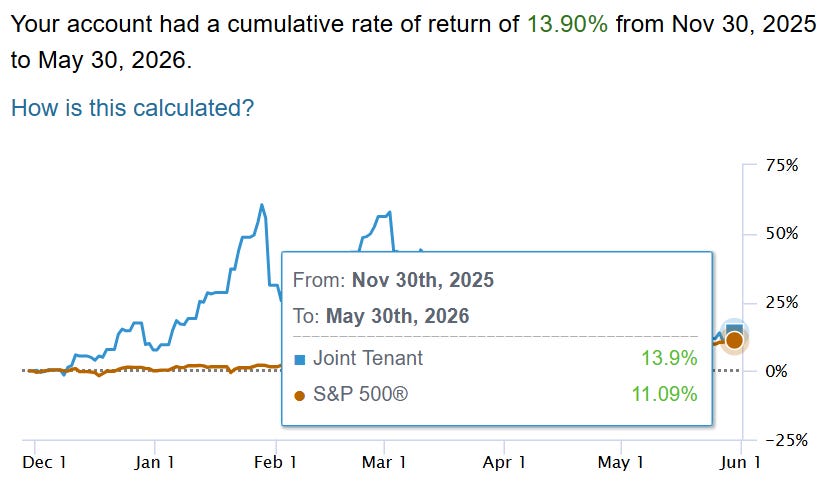
The X Project investment account (not including my physical bullion) is up 6.7x over the past four years. It was up 214% last year (12x vs. the S&P 500), and here is the performance, according to Schwab, over the past six months:
If you are interested in the details of my investment account and how I am managing it, please consider becoming a paid subscriber.
Keep reading with a 7-day free trial
Subscribe to The X Project’s Substack to keep reading this post and get 7 days of free access to the full post archives.