

How Does the Geopolitical Landscape Look Today?
Reviewing global relations, rivalries, and ideological clashes - Article #61

In this 14-minute article, The X Project will answer these questions:
I. Why this article now?
II. What are some missteps and wrong assumptions by the U.S.?
III. Are we in “New Cold Wars”?
IV. What type of rivalries are we dealing with?
V. What are the global impacts of regional conflicts?
VI. Are sanctions working?
VII. What is happening with global alliances?
VIII. What is the primary ideological confrontation?
IX. What does The X Project Guy have to say?
X. Why should you care?
Reminder for readers and listeners: nothing The X Project writes or says should be considered investment advice or recommendations to buy or sell securities or investment products. Everything written and said is for informational purposes only, and you should do your own research and due diligence. It would be best to discuss with an investment advisor before making any investments or changes to your investments based on any information provided by The X Project.
I. Why this article now?
In the post-Cold War era, the world witnessed a dramatic shift in geopolitical dynamics that continues to evolve rapidly. The X Project previously summarized several books on geopolitics, including the following by George Friedman:
And these books by Peter Zeihan:
The Absent Superpower: The Shale Revolution and a World Without America (2016)
Disunited Nations: The Scramble for Power in an Ungoverned World (2020)
The End of the World is Just the Beginning: Mapping the Collapse of Globalization (2022)
And finally, these two books:
It has been a couple of months since the last article on geopolitics, and so this article delves into top themes from recent geopolitical developments.
Reminder for readers and listeners: nothing The X Project writes or says should be considered investment advice or recommendations to buy or sell securities or investment products. Everything written and said is for informational purposes only, and you should do your own research and due diligence. It would be best to discuss with an investment advisor before making any investments or changes to your investments based on any information provided by The X Project.
II. What are some missteps and wrong assumptions by the U.S.?
We can now look back and assess what has happened since the end of the (original) Cold War, particularly the flawed assumptions about China's integration and the reset with Russia. The belief that economic engagement with China would lead to political liberalization has proven misguided. Instead, China has used its economic gains to bolster its authoritarian regime and expand its influence globally. Similarly, the numerous attempts to reset relations with Russia have failed to account for its leadership's deeply entrenched geopolitical ambitions, particularly under Vladimir Putin.
These missteps have had profound consequences. The U.S. assumed that economic interests would supersede geopolitical ambitions, underestimating both nations' willingness to pursue their strategic goals aggressively. This has manifested in military buildup and territorial assertiveness in China, particularly in the South China Sea and toward Taiwan. In Russia, the annexation of Crimea and the ongoing conflict in Ukraine reflect a clear disregard for Western diplomatic overtures. These developments highlight the need for a more nuanced understanding of global power dynamics and reassessing strategies that overly rely on economic integration as a tool for geopolitical stability.
III. What are the “New Cold Wars”?
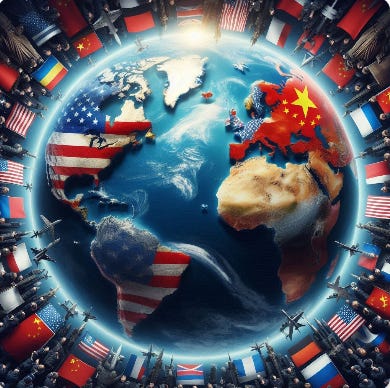
The "New Cold Wars" concept encapsulates the contemporary geopolitical rivalry primarily involving the United States, China, and Russia. Unlike the singular focus of the original Cold War between the U.S. and the Soviet Union, today's tensions are multifaceted, involving several major powers with overlapping and sometimes conflicting interests. The complexity of these relationships is heightened by global economic interdependence, making this new era of conflict more intricate and unpredictable. The term "New Cold Wars" underscores the renewal of old rivalries and the emergence of new fronts and issues, such as cyber warfare and space competition, which were less pronounced during the original Cold War.
The dynamic between the U.S., China, and Russia has evolved, with each nation pursuing its strategic goals while navigating the broader geopolitical landscape. China's rapid economic growth and its assertive policies in the South China Sea and toward Taiwan, along with Russia's aggressive actions in Ukraine and both of their attempts to undermine Western influence, have forced the U.S. to adapt its strategies, often reviving Cold War-era tactics such as containment and alliance-building, albeit in a more complex global context. This multipolar rivalry is characterized by a blend of military posturing, economic competition, and ideological clashes, making it distinct from the more straightforward bipolar competition of the 20th century.
IV. What type of rivalries are we dealing with?
The technological and economic dimensions of the new Cold Wars are critical, with the U.S. and China vying for supremacy in key high-tech sectors. Semiconductors, essential components in modern electronics, have become a focal point of this competition. The U.S. has implemented policies for onshore semiconductor production and restricted technology exports to China, aiming to maintain its technological edge and secure its supply chains. This strategic move is crucial for national security, given the reliance of both civilian and military technologies on advanced semiconductors.
For its part, China is aggressively investing in its semiconductor industry to reduce dependence on foreign technology and achieve self-sufficiency. This race extends beyond semiconductors to other technologies like artificial intelligence, 5G, and quantum computing. The outcome of this technological rivalry will have far-reaching implications for global economic leadership and military capabilities. Moreover, the economic interdependence between the U.S. and China complicates their rivalry. While competition is fierce, both economies are deeply integrated, making the stakes higher and the potential for collateral damage significant.
V. What are the global impacts of regional conflicts?
Regional conflicts such as the war in Ukraine, the tensions in the Taiwan Strait, and the Israeli-Hamas War have global repercussions. Russia's invasion of Ukraine has not only destabilized Eastern Europe but also strained global security architectures. It has tested the resolve of NATO and the European Union, prompting a re-evaluation of defense strategies and increased military spending among member states. The conflict has also disrupted global energy markets, given Europe's reliance on Russian gas, and highlighted vulnerabilities in global supply chains.
Similarly, the situation in Taiwan represents a potential flashpoint with far-reaching global consequences. Taiwan's strategic importance is underscored by its dominance in the semiconductor industry, vital for global technology sectors. Any conflict in the Taiwan Strait could severely disrupt the global economy, given the critical role that Taiwanese semiconductors play in various industries worldwide. The U.S. has increased its military presence in the Indo-Pacific and strengthened alliances with regional partners like Japan and Australia to deter Chinese aggression. These regional conflicts are not isolated incidents but are deeply intertwined with global strategic interests, underscoring the interconnected nature of contemporary geopolitics.
Finally, the Israeli-Hamas War has significant global impacts, reverberating far beyond the immediate conflict zone. Economically, it disrupts trade routes and heightens energy market volatility, particularly affecting oil prices given the region's strategic importance. Politically, it intensifies divisions within and between nations, influencing international relations and prompting diverse responses from global powers, ranging from calls for a ceasefire to outright support for either side. Humanitarian concerns are paramount, as the conflict leads to significant civilian casualties and displacement, triggering global humanitarian aid efforts and increasing pressure on international organizations to mediate. Moreover, the war fuels regional instability in the Middle East, potentially escalating tensions and conflicts in neighboring countries while also influencing global counterterrorism policies and strategies.
VI. Are sanctions working?
Economic sanctions have become a primary tool for the U.S. and its allies in managing geopolitical conflicts and containing rivals. Sanctions on Russia, particularly following its annexation of Crimea and the invasion of Ukraine, aim to weaken its economy and limit its capacity to sustain military operations. These measures have targeted various sectors, including finance, energy, and technology, to exert maximum pressure on the Russian state, but seem to have failed given Russia’s economy has not collapsed, and its military continues its fight in Ukraine. Similarly, export controls and trade restrictions on China are designed to curb its technological advancements and mitigate the risks posed by its rise. Still, China developed a highly advanced 7-nanometer chip at scale for Huawei’s latest generation phones.
Moreover, these sanctions can lead to unintended consequences. For instance, sanctions on Russia led to growing economic ties with China. Additionally, sanctions can create significant economic disruptions, not just for the targeted countries but also for global markets. The reliance on economic measures reflects a preference for non-military tools in addressing geopolitical challenges, but it also underscores such strategies' limitations and potential pitfalls. Policymakers must carefully balance the need to apply pressure with the risks of exacerbating global economic instability.
VII. What is happening with global alliances?
The U.S. and European sanctions on Russia and the confiscation of Russia’s U.S. Dollar and Eurodollar reserves following its invasion of Ukraine have driven Russia to a much closer economic and trading partnership with China. Russia and China have been increasing their economic and trade relationships with the “Global South,” a term used to describe the regions of Latin America, Asia, Africa, and Oceania. It is often employed to refer to countries that are generally less economically developed and are often contrasted with the wealthier, industrialized nations of the "Global North," which includes North America, Europe, and parts of East Asia.
Within the Global South is the BRICS organization, whose acronym is based on its original members: Brazil, Russia, India, China, and South Africa. More recently, Iran, Egypt, Ethiopia, Saudi Arabia, and the United Arab Emirates have joined. These countries form a geopolitical bloc emphasizing non-interference, equality, and mutual benefit in bilateral relations among its members. Additionally, they have established initiatives such as the New Development Bank, the BRICS Contingent Reserve Arrangement, and the BRICS basket reserve currency. These initiatives serve as alternatives to existing global financial institutions and demonstrate the BRICS members’ growing influence in the international arena.
In the current geopolitical climate, countries such as India, Saudi Arabia, and Brazil increasingly leverage the competition between major powers to their advantage. These nations adopt non-aligned or multi-aligned strategies, refusing to side unequivocally with the U.S. or China. Instead, they are positioning themselves to benefit from both, maximizing their strategic and economic gains. This shift reflects a more nuanced approach to international relations, where smaller powers can exert significant influence by balancing the interests of larger rivals.
The next section will examine the primary ideological confrontation. In Section IX, I will tell you what I think. Then, in Section X, why should you care and, more importantly, what more can you do about it. However, I have just hit a new paid subscriber threshold, so you must now be a paid subscriber to view the last three sections. The X Project’s articles always have ten sections. Soon, after a few more articles, the paywall will move up again within the article so that only paid subscribers will see the last four sections, or rather, free subscribers will only see the first six sections. I will be moving the paywall up every few weeks, so ultimately, free subscribers will only see the first four or five sections of each article. Please consider a paid subscription.
Also, podcasts of the full articles narrated are available only to paid subscribers.
All paid subscriptions come with a free 14-day trial; you can cancel anytime. Every month, for just the cost of two cups of coffee, The X Project will deliver 6-8 articles (weekly on Sundays and every other Wednesday), helping you know in a couple of hours of your time per month what you need to know about our changing world at the interseXion of commodities, demographics, economics, energy, geopolitics, government debt & deficits, interest rates, markets, and money.
You can also earn free paid subscription months by referring your friends. If your referrals sign up for a FREE subscription, you get one month of free paid subscription for one referral, six months of free paid subscription for three referrals, and twelve months of free paid subscription for five referrals. Please refer your friends!
VIII. What is the primary ideological confrontation?
Keep reading with a 7-day free trial
Subscribe to The X Project’s Substack to keep reading this post and get 7 days of free access to the full post archives.